Design: Corvette
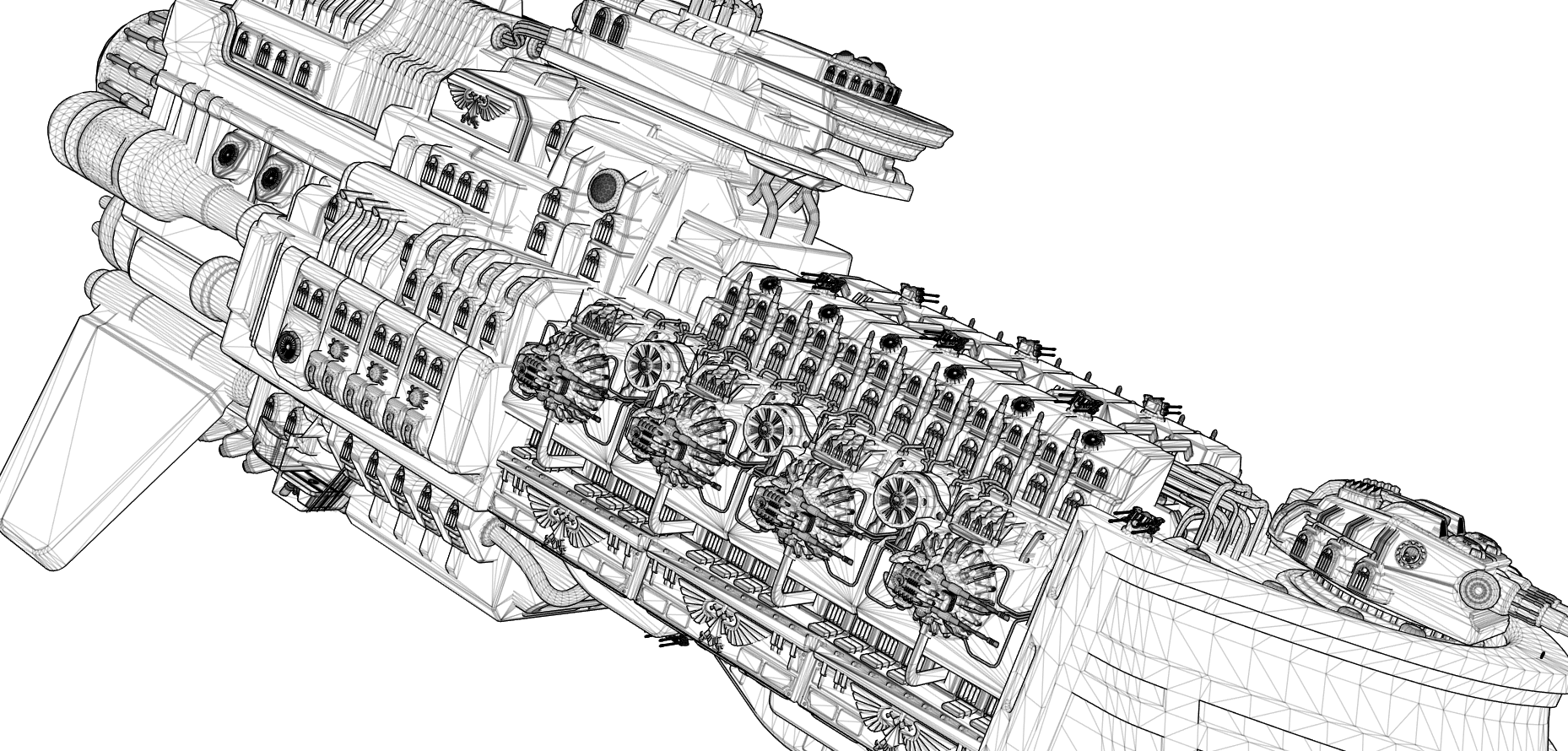
A side view of the ship, showcasing its detail centered around high-visibility sections, that benefitted from modelling details, rather than just texturing them.
At the end of 2025, I was commissioned for a Warhammer 40k ship, based on the Claymore-class corvette. While the ship itself had minimal reference material, I was able to extrapolate, and eventually it was decided to change the ship to better suit the role that the commissioner wanted it to have. The ship was designed to be put into a video game, with a full interior and full functionality, all while retaining its full scale. By February 2026, I had finished the exterior of the ship and had started to move on to the planning and mechanisms for the interior, which is currently being worked on.
This ship model marks a paradigm shift in my typical modelling process, as instead of blocking out the entire form and then moving on to detailing stages one by one, I decided to do a different process. I started work on the small stages first, ensuring that maximum detail was retained in those stages before I expanded. This style of modelling wasn’t the optimal one for cleanliness or time, but it did ensure that I retained a high level of detail throughout the ship model, rather than lacking later on in the process, as would be typical for detail passes. Doing the ship modelling in this piecewise way also ensured that each system would be mechanically and visually correct, as I was able to search up multiple references per section, due to the extra time and focus I had for each one. This is especially notable in the ship’s midsection, and around the cannons dotted on the sides of the hull, as their detail is at a more realistic small scale, rather than having the detail scaled proportionally with the size of the ship.
The interior is planned to be completed later this year and will include full decks, internal vehicle hallways, a ship-wide internal transport system, vehicle bays, and other features to ensure maximum adaptability and usability once it is within the game. Each component of the ship is designed to be boarded and walked upon, and that is why such a focus was given to the surface detail of the ship- and not just through texturing. Each window is able to be seen out of, as well as looked into, and the entire hull is designed with multiple vulnerabilities and entry points in mind for playability. While this model differs from typical CAD modelling, the detailing processes and designing the individual mechanisms of the parts have been transferable skills while using CAD. Doing large projects such as these also ensures that I don’t get bored during longer projects, and also allows me to pull from a chasm of creativity and mechanical interaction systems that have been kept in the back of my mind through modelling the smaller systems on projects like this.
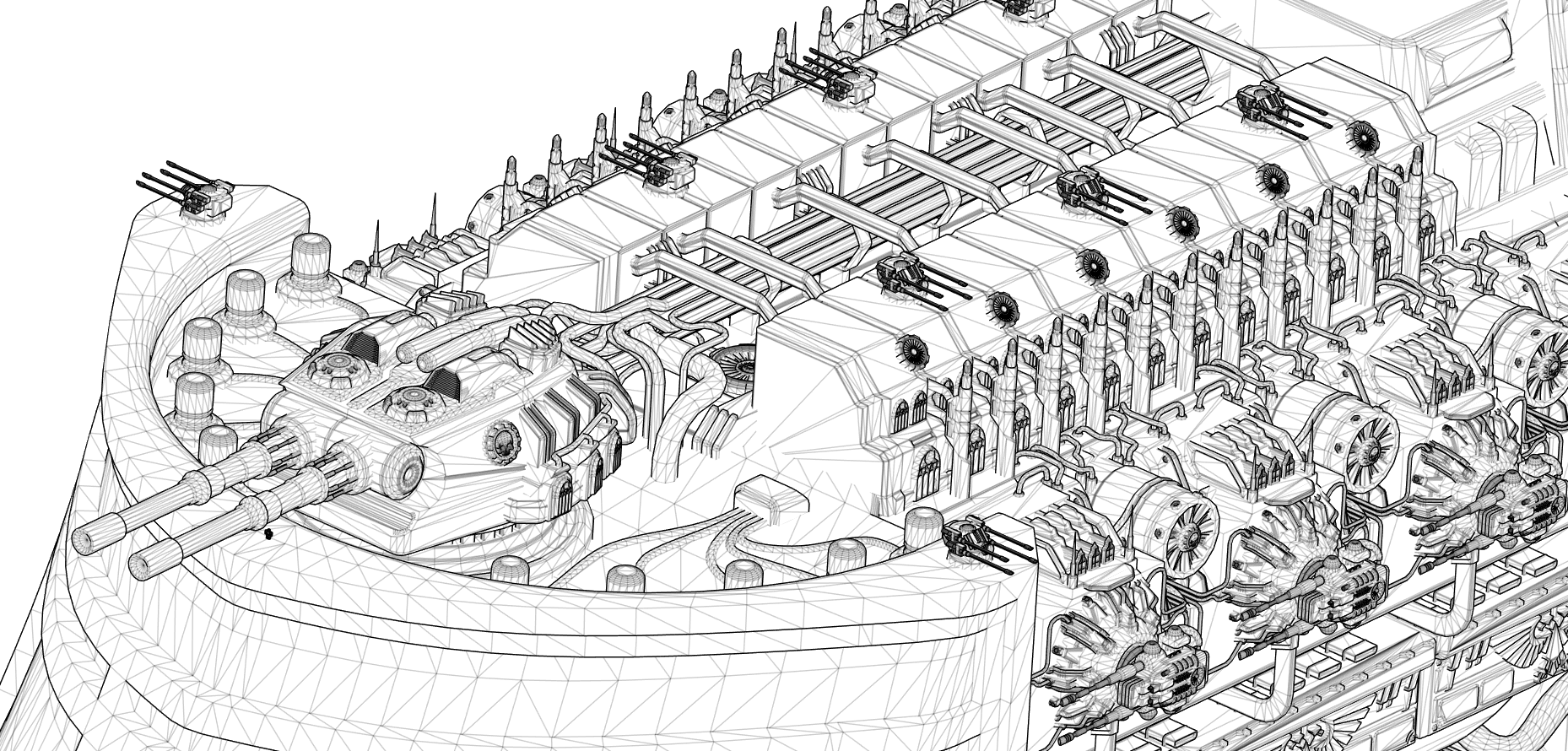
A close up of the middle and front hull’s top sections, highlighting the detail around the cannons, walkways, and inner trench.
